
Glycerin, also known as glycerol, is widely used in pharmaceuticals, cosmetics, food ingredients and chemical products. Depending on its source and production process, crude or partially refined glycerin may contain color bodies, odor-causing compounds and trace organic impurities.
Activated carbon is commonly introduced during the refining process to improve the color, odor and overall appearance of glycerin. Among the available options, wood-based powdered activated carbon is often selected for batch purification because of its rapid adsorption and developed pore structure.
Why Does Glycerin Require Purification?
Glycerin may be produced from vegetable oils, animal fats, biodiesel processes or other chemical routes. Before it can be used in higher-value applications, impurities from the raw materials and production process must be reduced.
Common purification targets include:
- Yellow, brown or other unwanted color bodies
- Residual odors and odor-forming organic compounds
- Trace oils, fatty substances and process by-products
- Organic impurities that affect product clarity and stability
Activated carbon is normally used as part of a broader refining process. It is particularly effective for the adsorption of color and organic impurities, but it does not replace distillation, ion exchange or other treatments used to remove water, salts and major contaminants.
How Activated Carbon Works in Glycerin Purification
During treatment, powdered activated carbon is mixed with the glycerin solution under controlled conditions. Impurity molecules diffuse into the carbon’s pore structure and are adsorbed onto its internal surface. After sufficient contact, the spent carbon is separated by filtration.
Because powdered carbon has a small particle size, it disperses quickly and provides fast contact with the liquid. However, glycerin has relatively high viscosity, which can influence mixing, adsorption speed and subsequent filtration. Process temperature, dilution, contact time and filtration equipment should therefore be evaluated together.
Why Use Wood-Based Powdered Activated Carbon?
Wood-based activated carbon can be produced with a developed mesoporous and macroporous structure. These pores are useful for adsorbing relatively large color molecules and organic impurities in liquid-phase applications.
Suitable wood-based powdered activated carbon may offer:
- Strong decolorization performance
- Rapid adsorption in batch treatment
- Good dispersion in glycerin solutions
- Effective removal of odor-causing organic compounds
- Flexible dosage adjustment according to the required purity
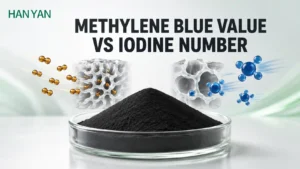
Nevertheless, a high iodine value alone does not guarantee better glycerin purification. Pore size distribution, surface chemistry and actual adsorption performance against the customer’s glycerin sample are often more relevant.
What Should Buyers Consider When Selecting Activated Carbon?
Activated carbon should be selected according to the glycerin source, initial color, impurity composition and target product specification. Important factors include:
- Decolorization capacity: The carbon should be tested against the actual glycerin solution rather than evaluated only by standard adsorption values.
- Purity: Ash, iron, heavy metals and soluble impurities should be controlled, especially for food, cosmetic and pharmaceutical applications.
- Particle size: Finer carbon may adsorb more rapidly, but it can also increase the filtration load.
- Filtration performance: The selected grade should be removed efficiently by the existing filtration equipment.
- Product loss: Excessive carbon dosage may increase glycerin retention in the filter cake and raise production costs.
Bench Testing Before Bulk Use
There is no universal activated carbon dosage suitable for every glycerin process. A laboratory test should be conducted using the customer’s actual material. Different carbon grades can be compared under the same temperature, dosage, contact time and filtration conditions.
The final selection should balance color removal, odor reduction, filtration speed, carbon consumption and glycerin recovery. The carbon with the highest adsorption index is not necessarily the most economical choice for the complete production process.
Wood-Based Activated Carbon Solutions from HANYAN
HANYAN supplies wood-based powdered activated carbon for liquid-phase decolorization and purification. Product specifications can be adjusted according to the required adsorption performance, particle size, pH, ash content and purity level.
Based on the customer’s glycerin source, treatment conditions and quality target, our technical team can provide product selection guidance and support sample testing before bulk supply.
Article Keywords: activated carbon for glycerin purification, glycerin decolorization, glycerol purification, wood-based activated carbon, powdered activated carbon, glycerin refining, decolorizing activated carbon