
Wood powder activated carbon is widely used in food and ingredient processing because many liquid systems require more than basic filtration. In many cases, the goal is not only to remove suspended solids, but also to reduce unwanted color bodies, trace organic impurities, and odor-causing substances that affect product appearance and process consistency.
For this type of application, wood-based powdered activated carbon is often a practical choice. Its pore structure, fine particle form, and strong liquid-phase adsorption behavior make it well suited to decolorization and purification steps in a wide range of food and ingredient processes. Industry market reports also note that powdered wood activated carbon is commonly used in food and beverage, pharmaceutical, and wastewater applications for decolorizing, purifying, and deodorizing.
Another reason it is widely used is process flexibility. Powdered carbon can be added into the liquid phase, mixed for contact, and then removed by filtration. This makes it suitable for batch processing and for systems where the decolorization target may vary from one product stream to another.
Why Buyers Often Choose Wood Powder Carbon for Decolorization
In practical use, buyers often look for a carbon that can balance adsorption efficiency with workable filtration performance. Wood powder activated carbon is commonly selected because it can support:
- effective removal of color precursors and organic impurities
- good contact efficiency in liquid systems
- application flexibility across different food and ingredient streams
- process adjustment through dosage and contact time
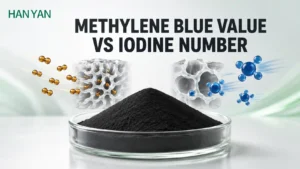
However, selecting a suitable grade should not depend on one number alone. A carbon that looks strong in one laboratory indicator may not perform best in an actual production system.
What Buyers Should Check Beyond a Single Test Value
For liquid-phase decolorization, buyers should usually evaluate several practical factors together, including decolorization performance, filtration behavior, ash level, particle fineness, and batch-to-batch consistency. Different liquids have different treatment priorities, so the most suitable grade depends on the actual process rather than on a single general specification.
In many cases, application matching matters more than chasing the highest possible value in one test item. A more balanced product may perform better in real production if it provides stable decolorization with manageable filtration and process control.
At HANYAN, we believe wood powder activated carbon selection should be based on actual liquid conditions, treatment targets, and process requirements. For food and ingredient processing, choosing the right grade is not only about adsorption capacity, but about how the carbon performs in the full decolorization step.
Article Keywords: wood powder activated carbon, decolorization activated carbon, food decolorization carbon, ingredient processing activated carbon, powdered activated carbon for food industry, wood-based activated carbon, liquid phase decolorization