
Glucose syrup is widely used in food processing, confectionery, beverages, bakery products, pharmaceuticals, fermentation, and other industrial applications. Depending on the raw material, production process, and operating conditions, glucose syrup may contain unwanted color bodies, residual odor compounds, colloidal materials, proteins, organic impurities, and other trace substances.
To improve clarity and product quality, many glucose syrup producers use powdered activated carbon during the purification stage. Among different activated carbon types, wood-based powdered activated carbon is commonly selected because of its developed pore structure, strong decolorization capability, and suitability for liquid-phase adsorption.
Why Glucose Syrup Requires Decolorization
During starch hydrolysis, enzymatic conversion, heating, concentration, and storage, glucose syrup can gradually develop color. This color may be caused by trace raw-material impurities, Maillard reaction products, oxidation products, proteins, colloids, or other organic compounds.
For many downstream uses, appearance is an important quality factor. Syrup with excessive color may affect the final appearance of confectionery, beverages, sweeteners, pharmaceutical formulations, and other processed products.
Activated carbon treatment helps remove many of these unwanted compounds before final filtration and concentration, supporting a cleaner and more consistent syrup appearance.
Why Wood-Based Powdered Activated Carbon Is Suitable for Glucose Syrup
Wood-based powdered activated carbon is widely used in liquid decolorization because it generally offers a suitable pore structure for adsorbing larger color molecules and organic impurities.
Compared with granular activated carbon, powdered activated carbon provides a larger external contact area and can disperse directly into the syrup during treatment. This allows the carbon to contact color bodies and impurities efficiently before it is removed through filtration.
For glucose syrup applications, wood-based powdered carbon is often valued for the following characteristics:
- Strong adsorption capacity for color bodies and organic impurities
- Developed mesoporous structure suitable for liquid-phase purification
- Fine particle size for good contact with the syrup
- Fast adsorption during controlled treatment time
- Suitable performance for food and starch sugar processing
- Flexible specifications for different decolorization requirements
Typical Glucose Syrup Decolorization Process
Although process conditions vary among producers, glucose syrup decolorization generally follows a similar treatment sequence.
- The glucose syrup is adjusted to a suitable temperature and process condition.
- Powdered activated carbon is added at a controlled dosage.
- The carbon and syrup are mixed for a defined contact time.
- The activated carbon adsorbs color bodies and other impurities.
- The treated syrup is filtered to remove spent carbon and adsorbed contaminants.
- The purified syrup continues to the next refining, concentration, or production stage.
The final result depends not only on the activated carbon itself, but also on syrup composition, treatment temperature, pH, dosage, contact time, and filtration conditions.
Key Factors That Affect Decolorization Performance
1. Type of Color Bodies and Impurities
Different glucose syrup streams may contain different impurity profiles. Some color compounds are relatively easy to adsorb, while others may require a carbon with a more suitable pore structure or a higher treatment dosage.
For this reason, a carbon grade that performs well for one syrup process may not always provide the same result in another production line.
2. Methylene Blue Value and Pore Structure
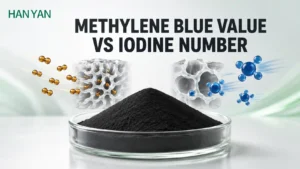
Methylene blue value is commonly used as a reference indicator for the adsorption of larger molecules. For liquid decolorization applications, it can provide useful information when comparing different wood-based powdered activated carbon grades.
However, buyers should not select carbon based on one value alone. The actual performance also depends on pore-size distribution, raw material source, ash content, particle size, and the composition of the syrup being treated.
3. Particle Size and Filtration Balance
Fine powder can improve contact between the activated carbon and the syrup. However, excessive ultrafine particles may make filtration more difficult in some systems.
A suitable powder grade should provide effective adsorption while remaining compatible with the customer’s filtration equipment and production cycle.
4. Carbon Dosage and Contact Time
Increasing carbon dosage may improve color removal, but it also increases material consumption and filtration load. Similarly, extending contact time may improve adsorption in some cases, but excessive treatment time may reduce overall production efficiency.
The most suitable dosage and contact time should be confirmed through laboratory trials or controlled production testing.
5. Syrup Temperature and Viscosity
Glucose syrup can be viscous, especially at higher concentrations. Temperature can influence viscosity, carbon dispersion, adsorption behavior, and filtration speed.
When evaluating carbon performance, it is important to test under conditions that are close to the actual production process.
What Buyers Should Confirm When Selecting Activated Carbon for Glucose Syrup
To select a suitable wood-based powdered activated carbon grade, buyers should provide as much process information as possible. Useful details include:
- Current syrup color and target color reduction
- Glucose syrup concentration and operating temperature
- Required particle size or mesh specification
- Methylene blue value or other required adsorption indicators
- Ash, moisture, and pH requirements
- Existing carbon dosage and contact time
- Filtration equipment and filter-aid conditions
- Whether the syrup will be used for food, pharmaceutical, or industrial applications
Clear process information helps suppliers recommend a carbon grade based on practical treatment performance rather than only a general product specification.
Why Product Consistency Matters
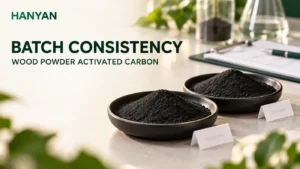
For glucose syrup producers, batch consistency is important. Changes in activated carbon performance can affect decolorization results, dosage requirements, filtration speed, and final product appearance.
A stable powdered activated carbon should offer consistent particle size, controlled ash and moisture levels, reliable adsorption performance, and suitable handling properties for repeated production use.
This is particularly important for customers operating continuous or high-volume syrup refining processes, where small performance changes may affect production efficiency and total treatment cost.
HANYAN Wood-Based Powdered Activated Carbon for Syrup Purification
HANYAN provides wood-based powdered activated carbon for liquid decolorization and purification applications, including glucose syrup, starch sugar, sweeteners, organic acids, food ingredients, and fine chemicals.
Our team can support customers with specification confirmation, sample evaluation, particle-size discussion, and product recommendations based on different syrup properties and purification targets.
For customers facing challenges such as insufficient color removal, high dosage, unstable filtration, or inconsistent treatment results, early communication about the full process condition can help identify a more suitable activated carbon solution.
Conclusion
Wood-based powdered activated carbon is widely used in glucose syrup decolorization because it can effectively adsorb many color bodies and organic impurities in liquid-phase treatment.
However, successful syrup purification depends on more than selecting a high-adsorption carbon. Pore structure, particle size, dosage, contact time, syrup viscosity, and filtration conditions should all be considered together.
By selecting a stable wood-based powdered activated carbon grade that matches the actual syrup process, producers can improve color removal, support more efficient filtration, and maintain more consistent final product quality.
Article Keywords: activated carbon for glucose syrup decolorization, glucose syrup activated carbon, wood-based powdered activated carbon, powdered activated carbon for sugar decolorization, starch sugar decolorization, activated carbon for syrup purification, food grade powdered activated carbon